
About the Mecklenburg County Clerk's Office
The Clerk of Superior Court is an elected official who serves the trial-court record-keeping function for Mecklenburg, which is Judicial District 26. The office is in the Mecklenburg County Courthouse and is open to the public the same hours as the courthouse, Monday through Friday, 9:00 a.m. to 5:00 p.m.
The clerk's office is split into divisions by record type, with separate emails for civil, criminal, and estate matters. The card below has the main contacts.
Clerk of Superior Court
832 East Fourth Street
Charlotte, NC 28202
PO Box 37971, Charlotte, NC 28237-7971
(704) 686-0400
Mon-Fri 9:00 a.m.-5:00 p.m.
What the Clerk Does in Mecklenburg County
The clerk handles the paperwork and records that keep cases moving. The office files pleadings, keeps the case files, issues process, collects fees, and acts in a judicial role for estates and special proceedings. The list below shows the core duties.
- Maintain Superior Court and District Court case files.
- Keep the judgment index under state law.
- Administer estates, guardianships, and special proceedings.
- Collect court fines, fees, and costs.
- Provide certified copies and public access at the courthouse.
The clerk also keeps the judgment index, which the Portal exposes as the NC Judgment Search under N.C.G.S. 7A-109(b)(6). That index matters for liens and collections, since a money judgment recorded by the clerk can affect property and credit.
Beyond filing and records, the clerk acts in a judicial role for estates and special proceedings. The clerk reviews estate applications, issues letters to a personal representative, and signs orders as an estate moves toward closing. This dual role, both record-keeper and judicial officer, is a key part of how North Carolina courts work.
How to Request a Certified Copy
A certified copy carries the clerk's seal and is what courts, agencies, and other states accept as official. A plain copy is fine for personal reference, but legal use usually needs the certified version. The steps below cover a request.
- Find the case number through the eCourts Portal or the clerk.
- Tell the clerk which document and how many certified copies you need.
- Pay the copy and certification fee the clerk quotes.
- Pick up in person or request delivery where offered.
For a file made before October 9, 2023 that is missing from the Portal, email the right division. Criminal files use Mecklenburg.Criminal@nccourts.org, civil files use Mecklenburg.Civil@nccourts.org, and estates use Mecklenburg.Estates@nccourts.org.
Plan ahead when a deadline is involved. A certified copy can take time to prepare, and a mailed request adds days. If you need the copy for a court filing, a name change, or another agency, order it early and confirm the office accepts your payment method before you send it.
Records Request Fields
Whether you ask by email or in person, the clerk needs a few details to find the file. The table lists what to include.
| Field | Required | Notes |
|---|---|---|
| Record Request Type | Yes | Criminal, civil, or estate |
| Party Names | Yes | Names tied to the case |
| File or Case Number | If known | Speeds the search |
| Document Type | Yes | Which filing you want |
| Number of Copies | Yes | Certified or plain |
Sending the right division email with these details is the fastest route for an older record. A vague request slows things down, since staff must guess which file you mean before they can pull it.
Mecklenburg County Clerk Payment Methods
Court copy and certification fees are set by statute and the current schedule, so ask the clerk for the exact amount. What is clear is how you can pay. Mailed payments must be a money order or certified check, never cash or a personal check. In-person payment accepts more options.
| Channel | Accepted | Notes |
|---|---|---|
| Money order, certified check | Payable to Mecklenburg County Clerk of Superior Court | |
| In person | Cash, card, money order, certified check | No personal checks; ATM on Level 2 |
| Online | Credit or debit card | Processing fees apply for eligible payments |
The court page explains the accepted methods for fines and fees.
See the Mecklenburg court payment information for mail, in-person, and online options.
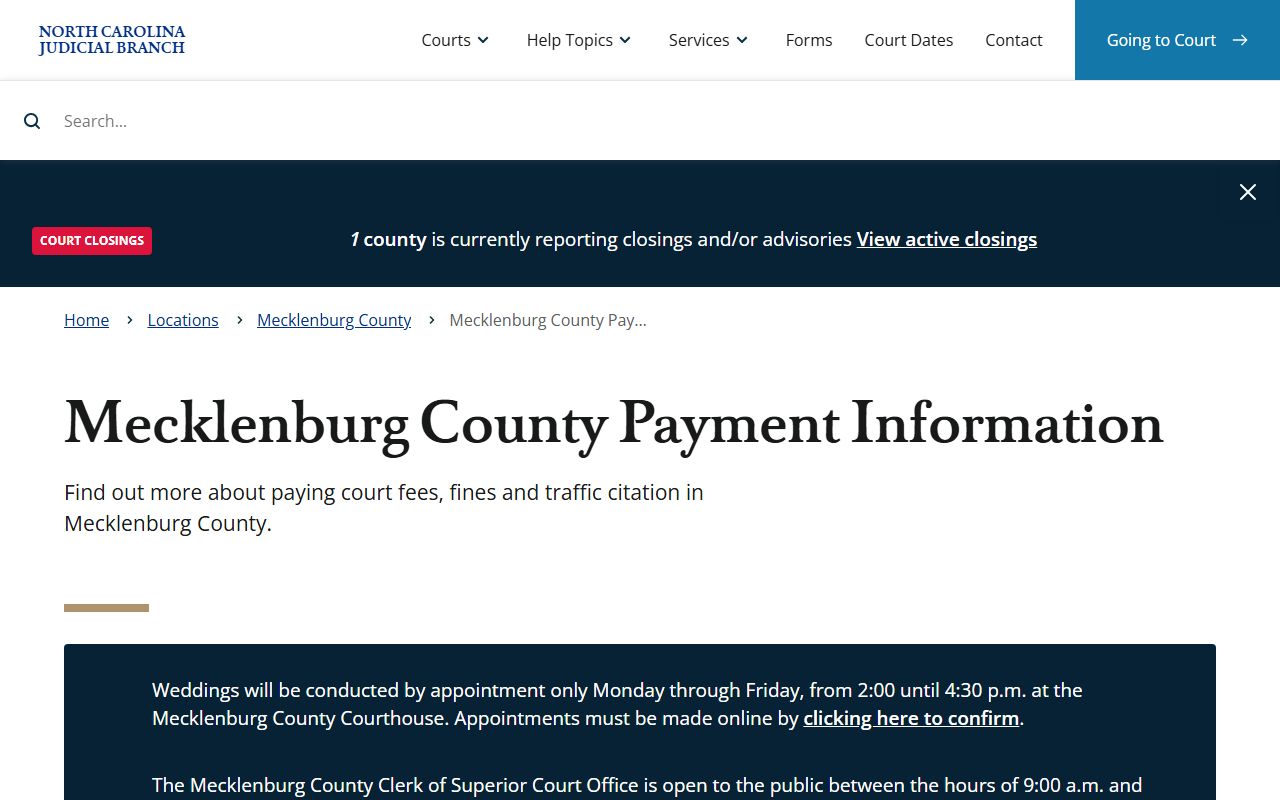
Card payments add a processing fee, and digital wallets like Apple Pay are not accepted on the portal.
Services at the Courthouse
The clerk's office shares the courthouse with services that help visitors. One is unusual and worth knowing about. Larry King's Clubhouse is a drop-in childcare center for children whose family members are doing courthouse business or serving as jurors.
See the Larry King's Clubhouse page for the courthouse childcare service.
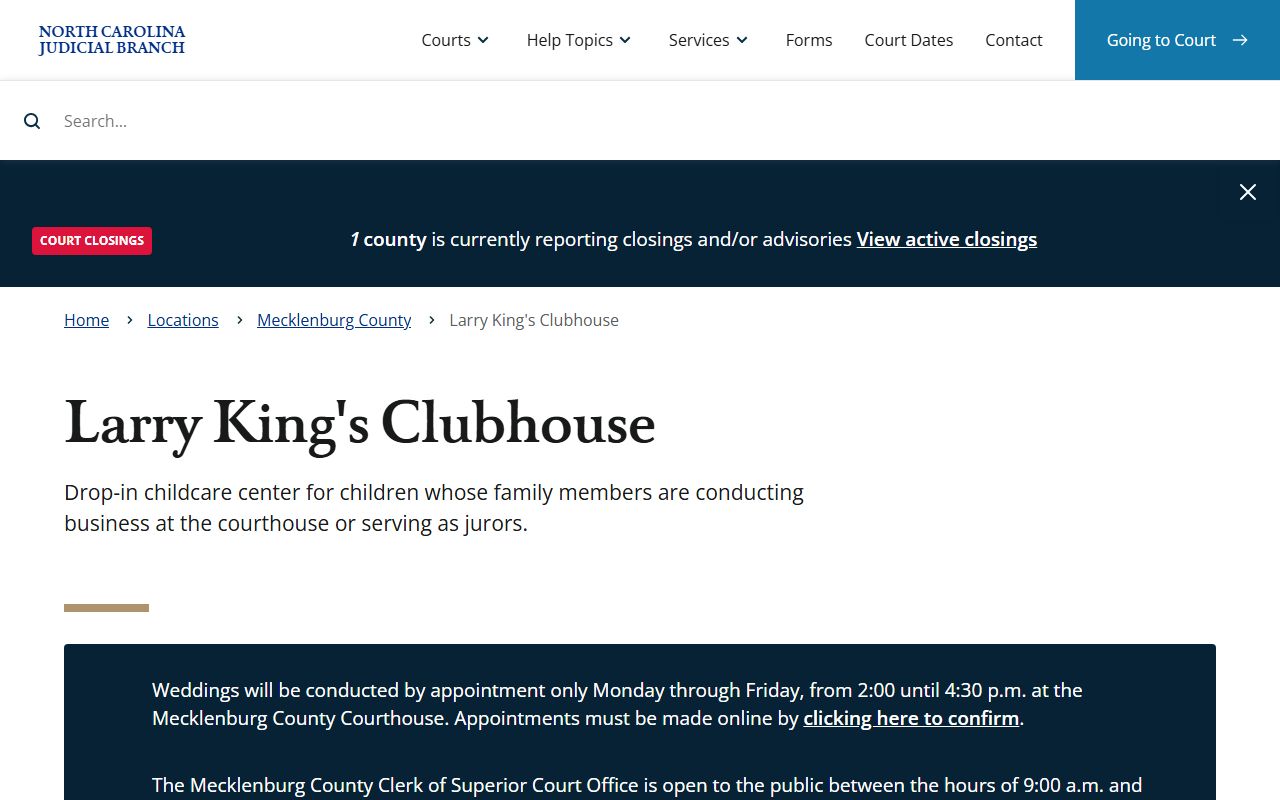
Services like this make a long records or court visit easier for families.
Court Programs and Recovery Court
The courthouse is also home to problem-solving courts that the clerk's records touch. Recovery Court, long active in Mecklenburg, marked 30 years in 2025. These programs combine judicial supervision with treatment for eligible participants.
See the Recovery Courts page for how these programs work statewide.
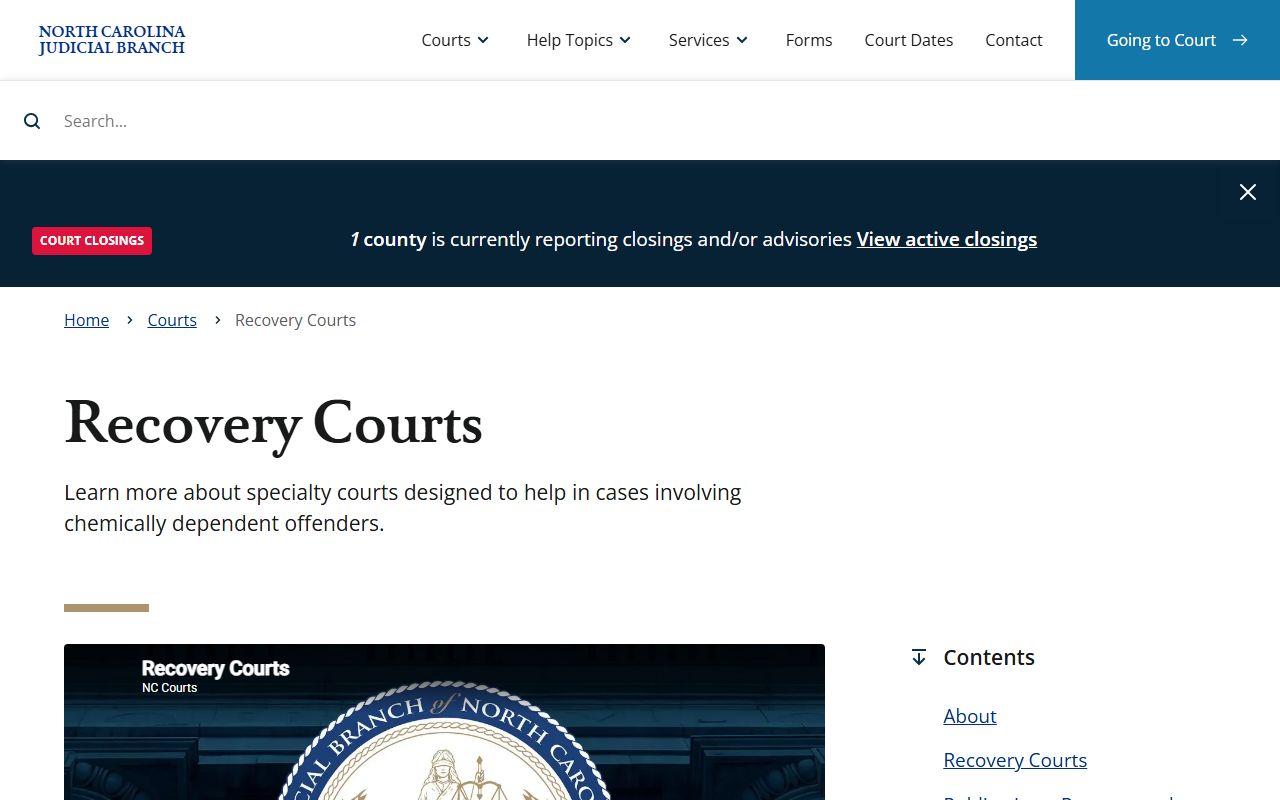
Case records from these courts may be partly restricted, especially where treatment details are involved.
Indigent Defense and Legal Help
People who cannot afford a lawyer may qualify for appointed counsel. North Carolina Indigent Defense Services manages defender resources in the county, and the Mecklenburg Public Defender represents eligible clients. Court-appointed counsel is not always free, since a convicted defendant may be ordered to repay appointed-attorney costs.
See Indigent Defense Services for Mecklenburg for defender information.
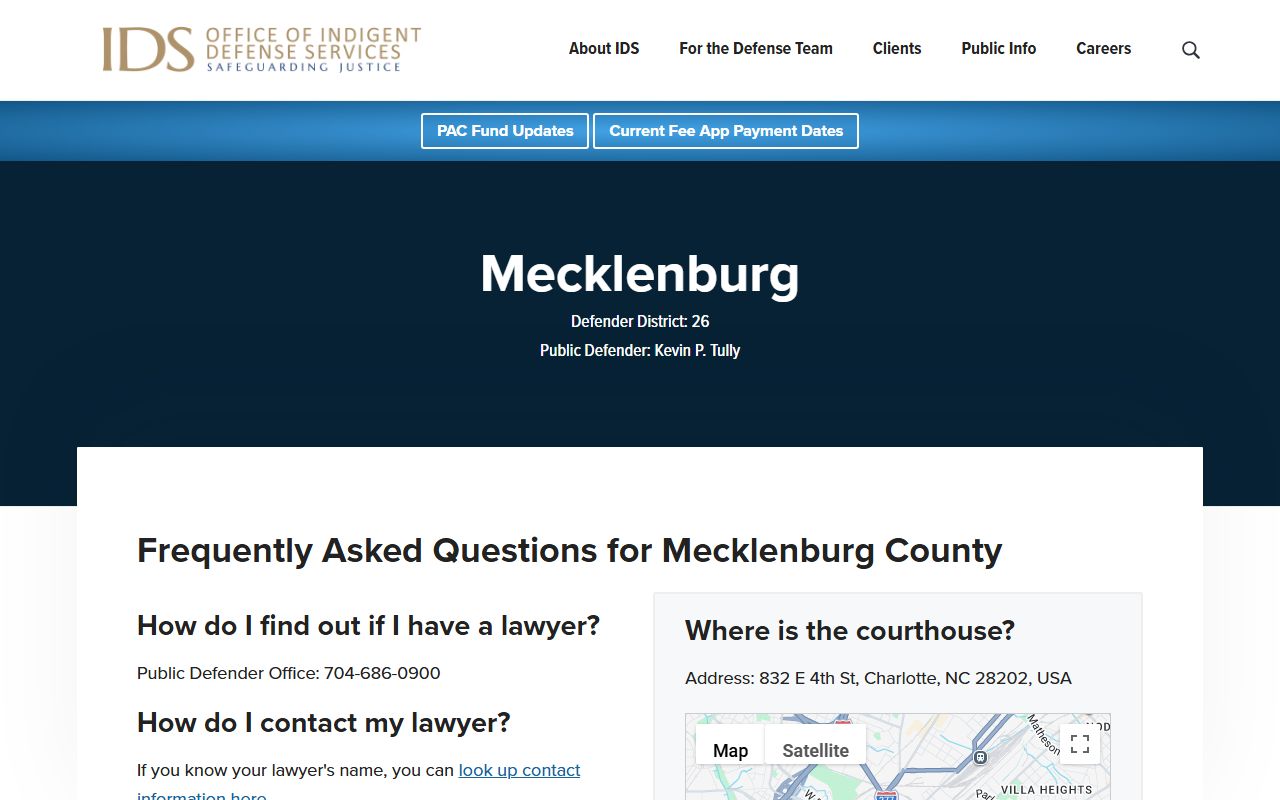
The local public defender office handles eligible criminal cases.
Visit the Mecklenburg Public Defender at 720 East Fourth Street, Suite 300, (704) 686-0900.
For a referral, the Mecklenburg County Bar Lawyer Referral Service is (704) 375-0120.
Clerk of Superior Court vs Register of Deeds
Many people mix up the clerk and the Register of Deeds. The clerk handles court cases, criminal and civil files, estates, judgments, and courtroom records. The Register of Deeds handles real estate recordings, marriage licenses, notary commissions, and many vital-record copies. So a court case copy comes from the clerk, while a marriage or deed copy comes from the Register of Deeds. The two offices even keep different hours and sit in different buildings, so it pays to confirm which one holds your record before you make a trip downtown.
Note: Court case files come from the Clerk of Superior Court, not the Register of Deeds, so send case-record requests to the clerk's division.