
Mecklenburg County District Court Overview
North Carolina runs one unified system called the General Court of Justice. District Court is the trial division that hears most everyday matters. It covers civil cases under $25,000, divorce, custody, child support, misdemeanors, infractions, traffic cases, juvenile delinquency and dependency, and magistrate matters. District Court is divided into 41 districts statewide and sits in each county seat.
Mecklenburg is District Court District 26 and Superior Court District 26. The county does not have county courts at law or justice of the peace courts. Instead, magistrates sit within District Court, and estate and special-proceeding work runs through the Clerk of Superior Court.
Superior Court hears all felony criminal cases and civil cases over $25,000, plus appeals from District Court misdemeanors and infractions. It rotates judges among districts, and each administrative district has a senior resident superior court judge. District Court is the busier trial court for most residents, since it handles the high-volume traffic, family, and misdemeanor work that touches everyday life.
Mecklenburg County Trial Court Offices
North Carolina does not use numbered trial courts the way some states do. Instead, District 26 offices are organized by function inside the courthouse. The table lists the main local court contacts.
| Office | Address | Phone |
|---|---|---|
| Superior Court Judges | 832 E. Fourth Street, Charlotte | (704) 686-0100 |
| District Court Judges | 832 E. Fourth Street, Charlotte | (704) 686-0101 |
| Family Court | 832 E. Fourth Street, Charlotte | (704) 686-0202 |
| Magistrates, Civil / Small Claims | 832 E. Fourth Street, Charlotte | (704) 686-0560 |
| Magistrates, Criminal | 832 E. Fourth Street, Charlotte | (704) 686-0050 |
| Clerk of Superior Court | 832 E. Fourth Street, Charlotte | (704) 686-0400 |
Jury management uses a separate line, (877) 649-7133, and the Trial Court Administrator is (704) 686-0260.
District Court vs Superior Court vs Magistrates
The three trial-level options differ by case size and type. District Court handles smaller and family matters, Superior Court handles felonies and larger civil cases, and magistrates handle the smallest civil claims and first criminal steps. The comparison shows the split.
| District Court | Superior Court | Magistrates | |
|---|---|---|---|
| Civil Limit | Under $25,000 | Over $25,000 | Small claims to $10,000 |
| Criminal Jurisdiction | Misdemeanors, infractions | Felonies | Warrants, bail, minor pleas |
| Family Cases | Yes | No | No |
| Examples | Traffic, custody, support | Robbery, large contracts | Evictions, liens |
How a Case Moves Through the Mecklenburg County System
Cases follow a path that depends on whether they are criminal or civil. A misdemeanor can be appealed from District Court to Superior Court for a new trial in the right case, and trial-court decisions can move up to the state appellate courts.
Criminal flow: Arrest › Magistrate / First Appearance › District or Superior Court › Plea or Trial › Sentencing › Appeal
Civil flow: Complaint Filed › Answer › Discovery › Mediation › Trial › Judgment › Appeal
Appeals: Trial Court › North Carolina Court of Appeals › Supreme Court of North Carolina
Civil, Family, and Criminal Divisions
The trial courts work in divisions. The civil division hears money and property disputes. The criminal division hears charges, from infractions in District Court to felonies in Superior Court. The family division hears divorce, custody, support, and domestic violence matters, with its own administration in Mecklenburg.
Family Court coordinates the family-law caseload so related cases about one family are handled together.
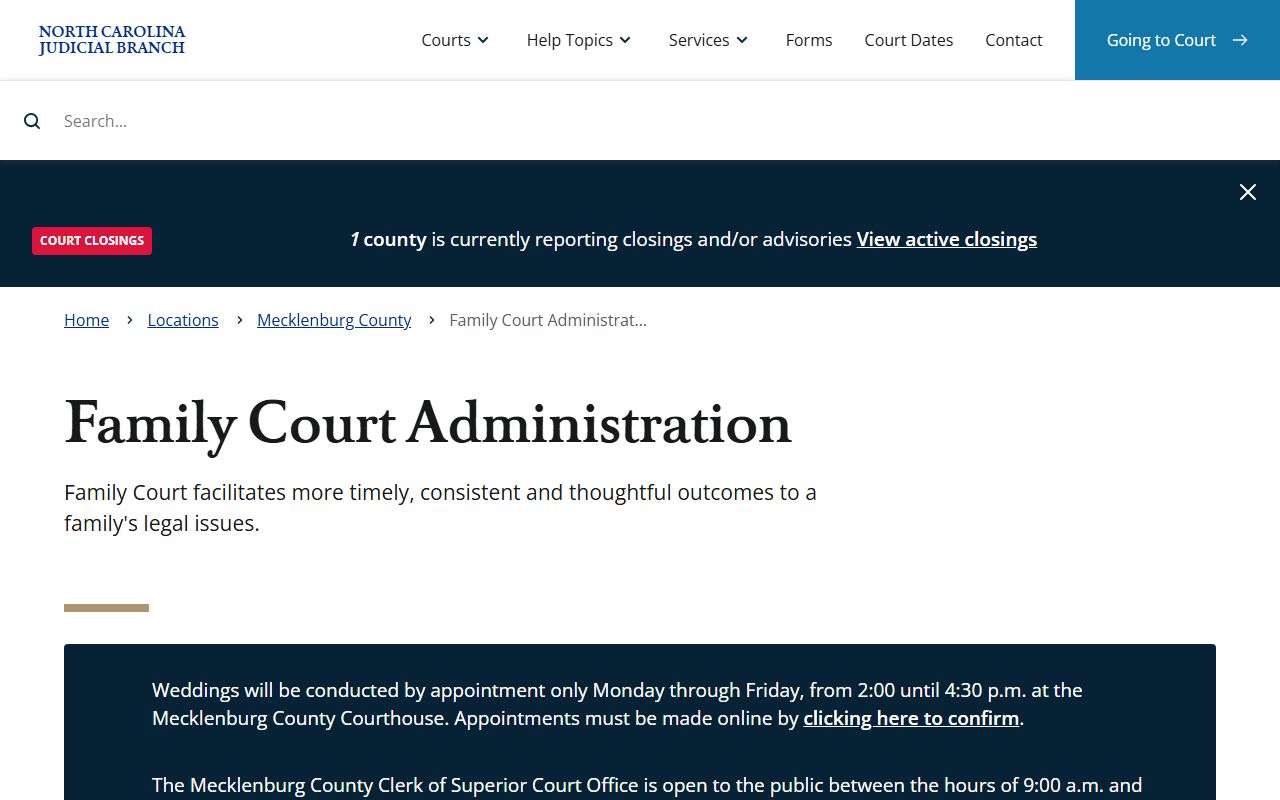
See the Family Court administration page for Mecklenburg.
Family cases often involve sensitive details, so parts of those files can be restricted.
The criminal division splits by severity. District Court handles misdemeanors and infractions, while Superior Court takes felonies and the more serious matters. A defendant convicted of a misdemeanor in District Court can appeal to Superior Court for a new trial in the right case. The civil division runs the same way, with smaller money disputes in District Court and larger ones in Superior Court.
Jury Service and Court Support
The trial courts depend on jurors and a set of support offices. Jury management handles summonses and questions at (877) 649-7133. Caseflow management, at (704) 686-0185, keeps cases moving through the system, and the Trial Court Administrator coordinates court operations. Guardian ad Litem services, at (704) 686-0075, represent the interests of children and incapacitated people in certain cases.
The courthouse also hosts problem-solving courts, including Recovery Court and Drug Treatment Court, that combine judicial supervision with treatment. These programs sit within the District 26 structure and serve eligible participants. Recovery Court has run in Mecklenburg long enough to mark a 30-year milestone in 2025, which shows how rooted these treatment courts have become in the county.
Judicial District 26
Mecklenburg makes up Judicial District 26, which covers both the Superior Court and District Court districts for the county. Superior Court was established in 1777 and is the state's oldest trial court, organized into divisions and districts statewide, with judges who rotate among districts. Each administrative superior court district has a senior resident superior court judge, and District Court has a chief district court judge for administrative duties. The Business Court, a specialized Superior Court forum, can take complex business cases by assignment of the Chief Justice. District 26 also includes the prosecutorial district, where the elected District Attorney handles criminal cases for the county. All of these pieces share the same courthouse, which keeps the county's trial-court work in one Uptown location.
Magistrates and Lower Courts
Magistrates are the entry point for many matters. In civil cases they hear small claims up to $10,000, evictions, recovery of personal property, and certain liens. In criminal cases they issue arrest warrants, set bail, and accept some guilty pleas and waivers for minor offenses. Mecklenburg keeps separate lines for civil and criminal magistrates, which avoids confusion since they handle very different work. North Carolina does not use county justice of the peace courts, so these magistrate functions sit inside District Court.
Magistrates are often the first judicial officer a person meets. In a criminal matter, a magistrate can review the charge, set the conditions of release, and decide the bond. In a small-claims case, the magistrate hears the dispute and enters a judgment. Because those decisions can be appealed to District Court in the right cases, magistrate matters feed directly into the larger trial-court system.
Note: Criminal and civil magistrates use different phone numbers, so confirm which one matches your matter before you call.