
How to Search Mecklenburg County Court Records
The main tool is the North Carolina eCourts Portal at portal-nc.tylertech.cloud. The portal home shows four tiles: Smart Search for case records, Search Hearings for court dates, Make Payments for eligible fines and citations, and NC Judgment Search for the judgment index. You do not need an account to use the public search tiles. The system runs on JavaScript and uses cookies, and Tyler Technologies posts a CAPTCHA challenge every five minutes for all users.
One local date matters a lot. Starting October 9, 2023, Mecklenburg public case information, court dates, and document copies moved into the Portal. A file made before that date may not appear online. If it does not, you email the right Clerk of Superior Court division and ask for it.
The official Mecklenburg County page on the state court site links the Portal, court dates, forms, and local programs in one place.
Most readers begin at the county landing page below, which collects the Portal links, the courthouse address, and the contact directory.
The county landing page is the cleanest single starting point for a Mecklenburg County Court records search.
Open the Mecklenburg County court landing page to see the Portal tiles and local links.
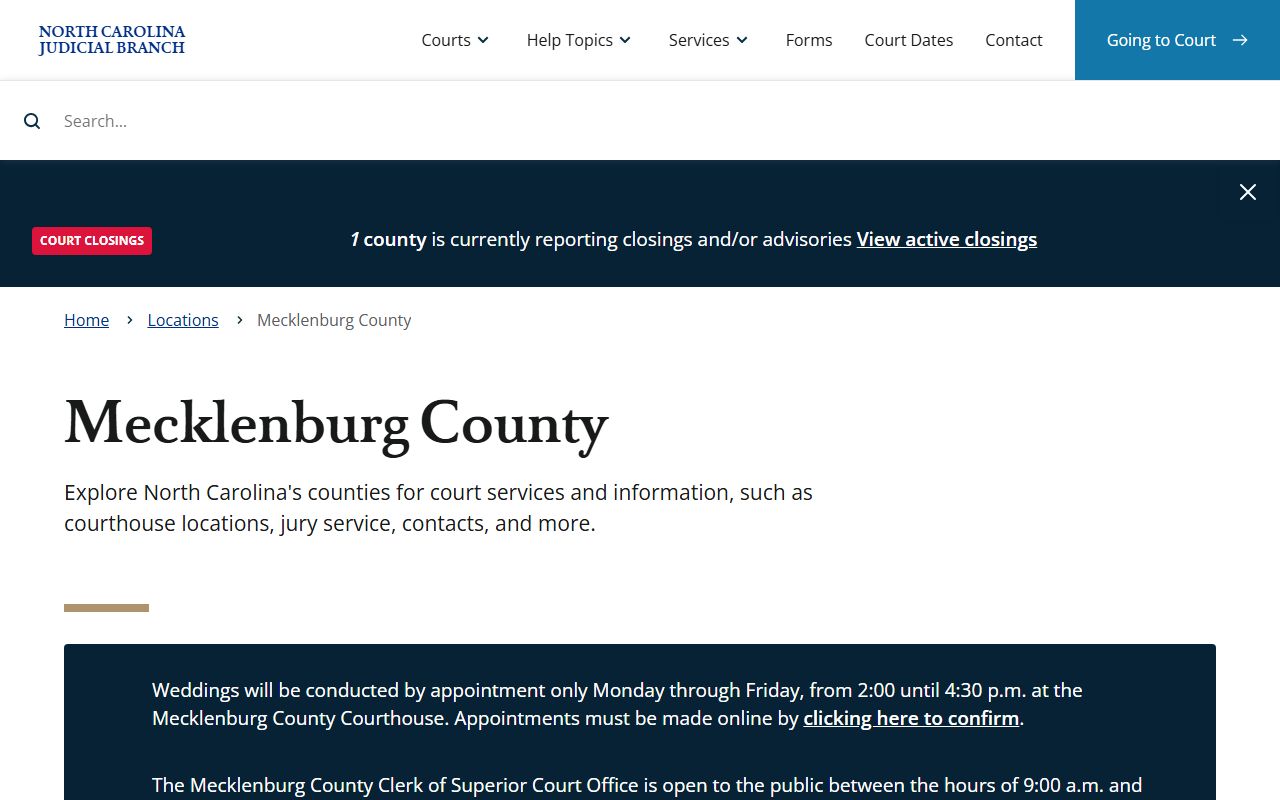
That page keeps the official record links current, so it is worth bookmarking before you start a search.
- Open the eCourts Portal and pick Smart Search for cases or Search Hearings for court dates.
- Enter a record number, or a name in Last, First Middle Suffix order.
- Open Advanced Filtering Options and set Location to Mecklenburg County to cut statewide noise.
- Add a case type, case status, or file-date range when the name is common.
- Open the case to read parties, events, hearings, and any available documents.
- For a file before October 9, 2023 that is missing, email the correct Clerk division with the record type, party names, and file number.
Here is the Portal home that those steps open.
View the eCourts Portal home with its Smart Search, Search Hearings, Make Payments, and NC Judgment Search tiles.
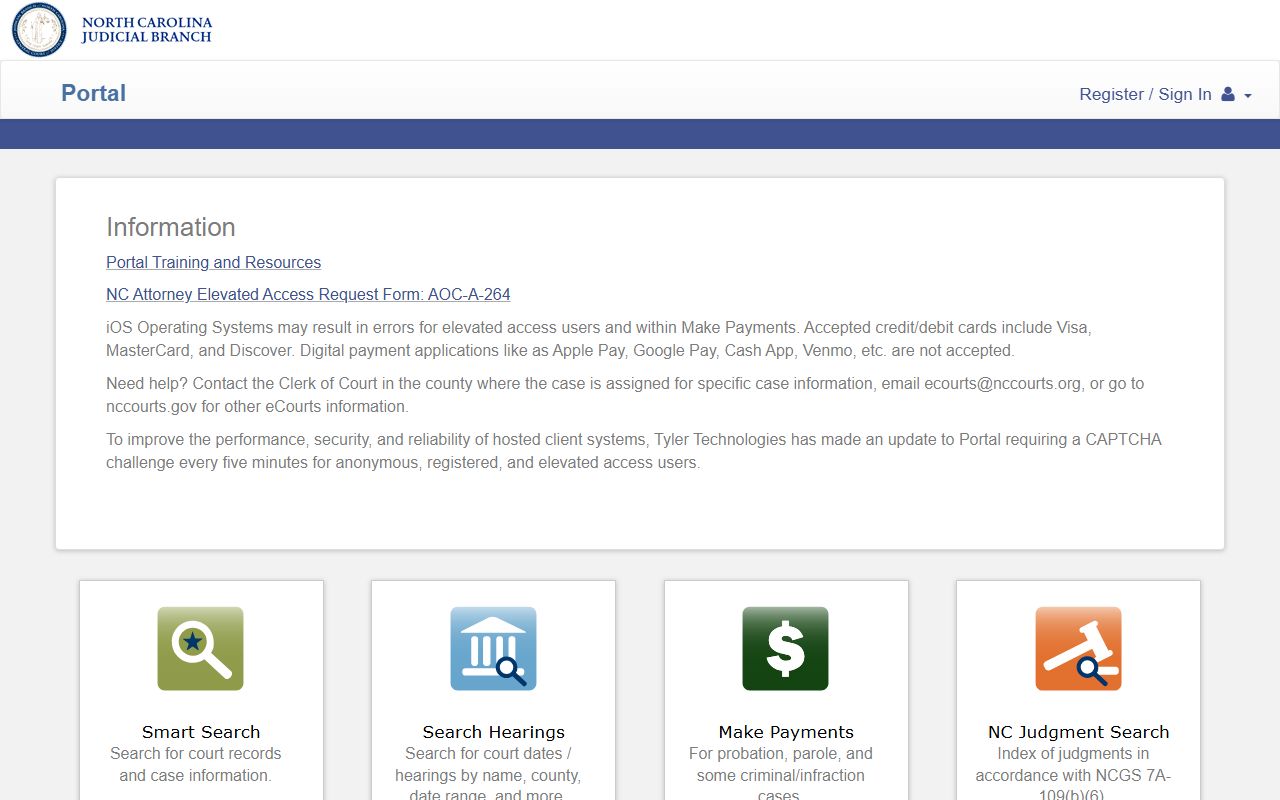
Each tile leads to a different search, so pick the one that matches what you need before you type a name.
Mecklenburg County Court Records Search Fields
Smart Search uses one top box plus an advanced panel. The fields and rules below come straight from the portal instructions, and the wildcard counts trip up most first-time searchers.
| Field | Type | Required | Notes / Format |
|---|---|---|---|
| Record Number or Name | Text | One criterion | Name in Last, First Middle Suffix format |
| Last Name | Text | Conditional | Three or more letters plus an asterisk for a wildcard |
| First Name | Text | Conditional | One or more letters plus an asterisk for a wildcard |
| Filter by Location | Dropdown | No | Choose Mecklenburg County |
| Filter by Case Type / Status | Dropdown | No | Narrows results in Advanced Filtering Options |
| File Date Start / End | Date | No | Limits results to a filing window |
The Mecklenburg County Judicial System
North Carolina runs one unified system called the General Court of Justice. At the trial level, Superior Court hears felony criminal cases and civil cases over $25,000, while District Court hears misdemeanors, infractions, traffic, family law, juvenile matters, and civil cases under $25,000. Magistrates sit within District Court and handle small claims up to $10,000, evictions, and certain criminal first steps like issuing arrest warrants and setting bail. The elected Clerk of Superior Court keeps the case files for both trial courts.
Mecklenburg is Judicial District 26 and Prosecutorial District 26. Superior Court Judges can be reached at (704) 686-0100 and District Court Judges at (704) 686-0101. Appeals from the trial courts move up to the North Carolina Court of Appeals and then, in some cases, the Supreme Court of North Carolina.
Case flow: Magistrate / District Court › Superior Court › Court of Appeals › Supreme Court of North Carolina
| Court | Jurisdiction | Case Types |
|---|---|---|
| Superior Court | Felonies and civil over $25,000 | Felony crime, large civil, District Court appeals |
| District Court | Misdemeanors and civil under $25,000 | Traffic, family, juvenile, infractions |
| Magistrates | Small claims up to $10,000 | Evictions, liens, warrants, bail |
| Clerk of Superior Court | Records and estates | Filings, judgments, probate, copies |
The county contact directory lists every local court phone number in one place.
See the Mecklenburg court contact directory for the clerk, judges, magistrates, family court, and jury office.
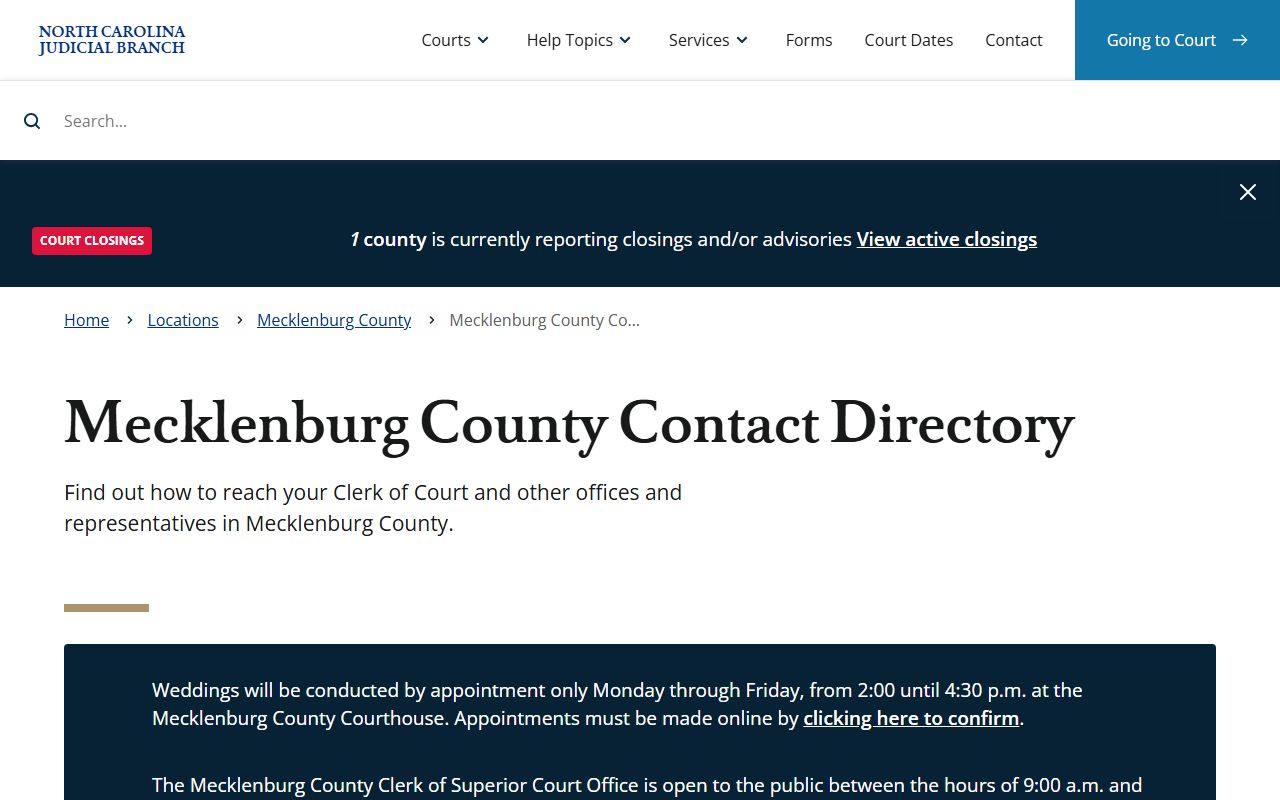
Pick the office that handles your case type before you call, since the clerk, DA, and magistrate lines are separate.
Mecklenburg County Courthouses
The main building is the Mecklenburg County Courthouse at 832 East Fourth Street in Uptown Charlotte. It houses Superior Court, District Court, the Clerk of Superior Court, magistrates, jury functions, family court administration, the SelfServe Center, and Recovery Court. Two nearby buildings round out the justice complex. The Register of Deeds sits in the County and Courts Office Building at 720 East Fourth Street, and the District Attorney works from 700 East Trade Street.
The courthouse and the clerk's office keep the same public hours, Monday through Friday, 9:00 a.m. to 5:00 p.m. The official courthouse page lists parking, security rules, and the prohibited-item list.
Read the official Mecklenburg County Courthouse page for hours, parking, and security details.
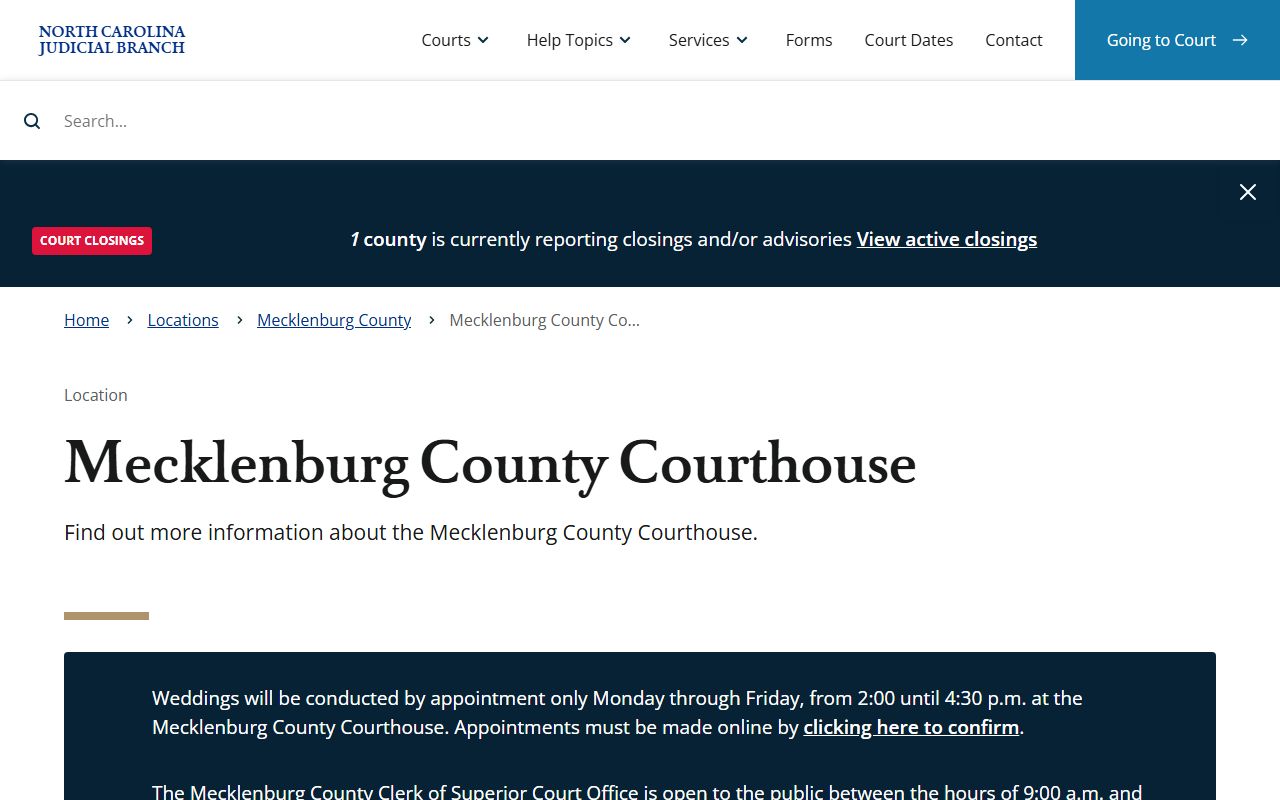
Plan for security screening, since the building uses metal detectors and bag x-ray at the public entrance.
Mecklenburg County Courthouse
832 East Fourth Street
Charlotte, NC 28202
(704) 686-0400
District Attorney, District 26
700 East Trade Street
Charlotte, NC 28202
(704) 686-0700
Types of Court Records Available in Mecklenburg County
Court records in Mecklenburg fall into a handful of groups, and each one comes from a different court division. Superior Court produces felony and large civil files. District Court produces misdemeanor, traffic, family, and small-claims files. The Clerk of Superior Court holds estate and special-proceeding records. Marriage licenses are a separate office entirely.
The list below shows the main record types and where each one comes from.
- Criminal records - warrants, charges, pleas, judgments, and sentencing from Superior and District Court.
- Civil records - complaints, answers, motions, orders, and money judgments.
- Family and divorce records - divorce, custody, child support, and protective orders in District Court.
- Probate and estate records - wills, estate administration, and guardianships before the clerk.
- Traffic court records - citations, infractions, and traffic misdemeanors with court dates and fines.
For dockets and court dates, the state calendar portal and Search Hearings cover both civil and criminal settings.
Open the North Carolina court calendars portal linked from the county page.
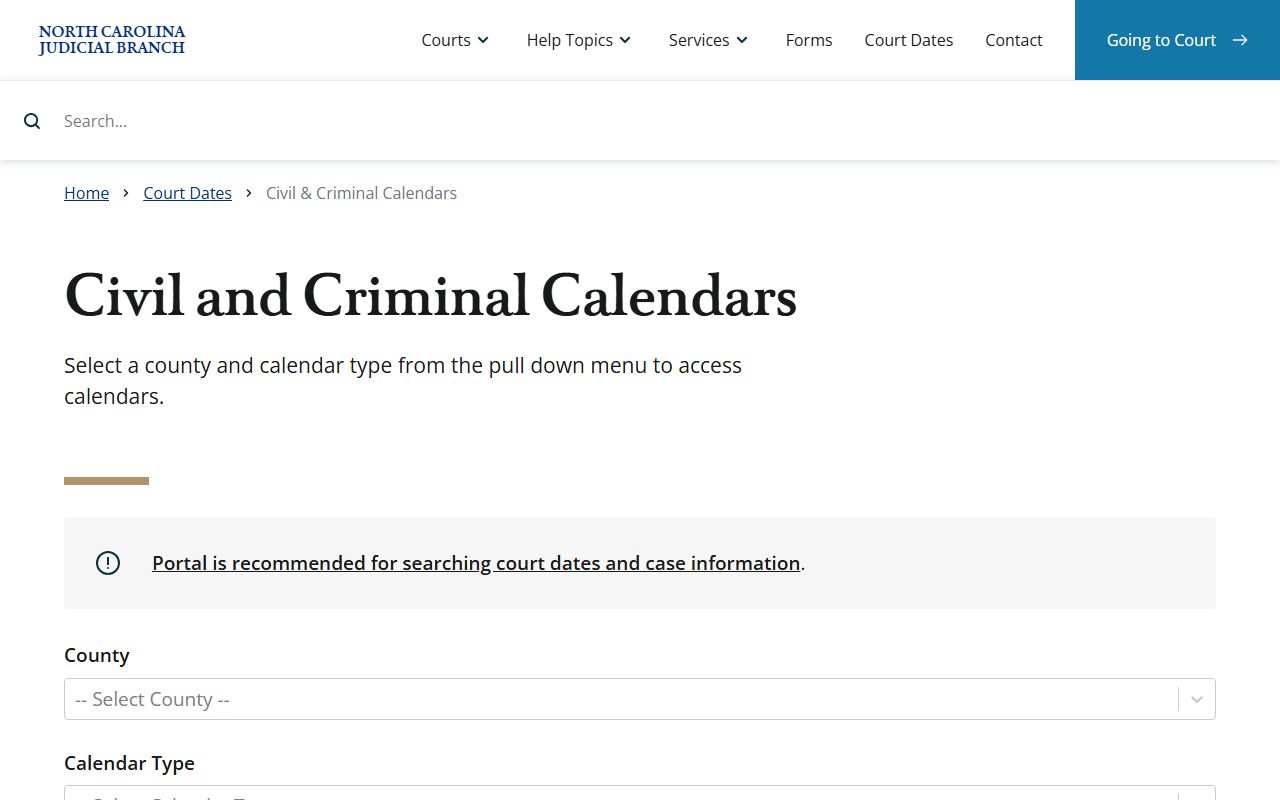
Use Mecklenburg County court dockets for a full walkthrough of hearing searches.
What Mecklenburg County Court Records Show
A case record is built from fields. Some come from the clerk's file, and some come from the search result itself. The table below lists the common fields and what each one tells you. Criminal and traffic files add charge, bond, and disposition details on top of these.
| Field | What It Shows |
|---|---|
| Case Number | The clerk's unique file number; wildcard search needs four or more characters. |
| Filing Date | The date the case was opened with the clerk. |
| Parties | Plaintiff and defendant, or state and defendant, or petitioner and respondent. |
| Charges / Cause | The charge in a criminal case or the claim in a civil case. |
| Disposition | The outcome, such as dismissed, guilty, judgment, or pending. |
| Sentence / Judgment | The penalty or money award once the case is decided. |
The judgment index is its own search, kept by the clerk under state law.
Open the NC Judgment Search, described by the Portal as the judgment index under N.C.G.S. 7A-109(b)(6).
Judgments matter for liens and collections, so this index is a useful second stop after Smart Search.
Public Access Laws for Mecklenburg County Court Records
North Carolina opens most government records by default. The public records law lives in Chapter 132 of the General Statutes. Court files add their own rules on top, and some records stay confidential no matter what. Court case access also follows clerk recordkeeping statutes and eCourts access policy.
Anyone can inspect open records at reasonable times. Agencies can charge actual copy costs and certain service fees. They do not have to produce records that another law makes confidential.
Key Statutes:
N.C.G.S. § 132-1 - defines public records broadly for state and local agencies.
N.C.G.S. § 132-6 - gives the public the right to inspect and copy records.
N.C.G.S. § 7A-109 - sets the records and judgment index the clerk must keep.
For records held by the courts themselves, the Judicial Branch runs its own request service.
Use the Judicial Branch public-record request for administrative records that are not in the Portal.
Records That Are Restricted or Confidential
Not every file is open. Juvenile records are withheld under Chapter 7B, including N.C.G.S. 7B-3000. Adoption records are confidential under Chapter 48. Expunged cases come off public access once a judge signs the order. Sealed cases, mental health files, and grand jury materials are closed or shown only as a notation. Personal data like Social Security numbers and minors' names is redacted from public copies.
To view a sealed record, a person usually needs to be a party, an attorney of record, or someone with a court order. A motion to unseal goes to the judge who can weigh the request against the reason the file was closed.
Specialty Courts in Mecklenburg County
Mecklenburg runs several problem-solving courts that mix judicial supervision with treatment. Recovery Court, also called Drug Treatment Court, is the best known. In 2025 the Judicial Branch marked 30 years of Mecklenburg County Recovery Court, which places its start in the mid-1990s. The Drug Treatment Court line is (980) 314-1950.
The county page also lists Mental Health Court, Adult Treatment Court, Youth Treatment Court, Family Treatment Court, and DWI Treatment Court. These programs serve people whose court involvement is tied to substance use or mental health. Case details from these courts may still be restricted, especially where juveniles or treatment records are involved.
Mecklenburg County Sheriff and Jail
The Mecklenburg County Sheriff's Office runs the county detention system and posts arrest and resident lookup tools. Sheriff Garry L. McFadden has led the office since December 2018. The resident inquiry page reminds users that a charge is not a conviction, since many people are charged without being convicted. Arrest and resident inquiry data stays online for three years from arrest or release.
For the full jail roster, search fields, and code glossary, see Mecklenburg County inmate records. For active warrants and process types, see warrant records. For release verification and notifications, see released inmates.
Marriage, Divorce, and Probate Records
These records split across two offices. The Register of Deeds issues marriage licenses and certified marriage copies. The courts hold divorce files and probate matters. Divorce is a District Court family-law case, and probate runs through the Clerk of Superior Court estates division. See marriage and divorce records and probate records for the full process and fees.
- Testator
- A person who makes a will.
- Executor
- The person named in a will to settle the estate.
- Intestate
- Dying without a valid will, so state law decides who inherits.
- Guardian ad litem
- A person appointed to protect a child's or incapacitated person's interests.
Mecklenburg County Court and Record Fees
Court copy and certification fees are set by statute and the clerk's current schedule, so ask the clerk for the exact amount before you mail a payment. The Register of Deeds publishes precise vital-record and copy fees, shown below. Court payments by mail must be money order or certified check, payable to Mecklenburg County Clerk of Superior Court.
| Item | Amount |
|---|---|
| Marriage license (Register of Deeds) | $60 |
| Certified marriage copy | $10 each |
| Certified birth or death copy | $10 each |
| Certified real estate copy | $5 first page, $2 each added page |
| Non-certified copy in person | $0.25 per page |
| Court copy and certification fees | Ask the Clerk of Superior Court |
How to Interpret Mecklenburg County Court Records
Court files use shorthand. A disposition of dismissed means the charge ended without a conviction. A judgment is the court's final decision. In the Sheriff's system, charge type codes read M for misdemeanor, F for felony, T for traffic, and I for infraction. Bond type codes include SEC for secured, UNS for unsecured, and CASH for cash only.
The most important point is simple. An arrest is not a conviction. A booking record shows that someone was charged, not that a court found them guilty. To learn the outcome, read the court case in the Portal, where the disposition shows whether the charge was dismissed, pending, or resolved with a plea or verdict.
Note: Online status can lag the paper file, so confirm any charge, bond, or disposition with the clerk before you rely on it for a legal or job decision.
History of Mecklenburg County Courts
Charlotte has long been the county seat, and the courthouse at 832 East Fourth Street now anchors a justice complex that grew across Uptown. North Carolina Superior Court dates to 1777 and is the state's oldest trial court. District Court and the magistrate system came later as part of the unified General Court of Justice. Mecklenburg Recovery Court adds local depth, with a 30-year milestone celebrated in 2025. The courthouse even runs Larry King's Clubhouse, a drop-in childcare center for families doing court business or serving as jurors.
Self-Help and Legal Aid in Mecklenburg County
People without a lawyer can use the 26th Judicial District SelfServe Center at the courthouse, Suite 3350. It is open Monday through Friday, 8:30 a.m. to 4:30 p.m., and the phone is (704) 686-0210. Staff hand out forms and instructions for child support, custody, visitation, domestic violence, limited driving privileges, and small claims. They cannot give legal advice, fill out forms for you, or say what to tell a judge.
For a lawyer, the Mecklenburg County Bar Lawyer Referral Service is (704) 375-0120 and the statewide line is 1-800-662-7407. Low-income residents can reach Legal Aid of North Carolina at (704) 376-1600. The public defender handles eligible criminal cases.
See the SelfServe Center page for topics, hours, and pro se forms.
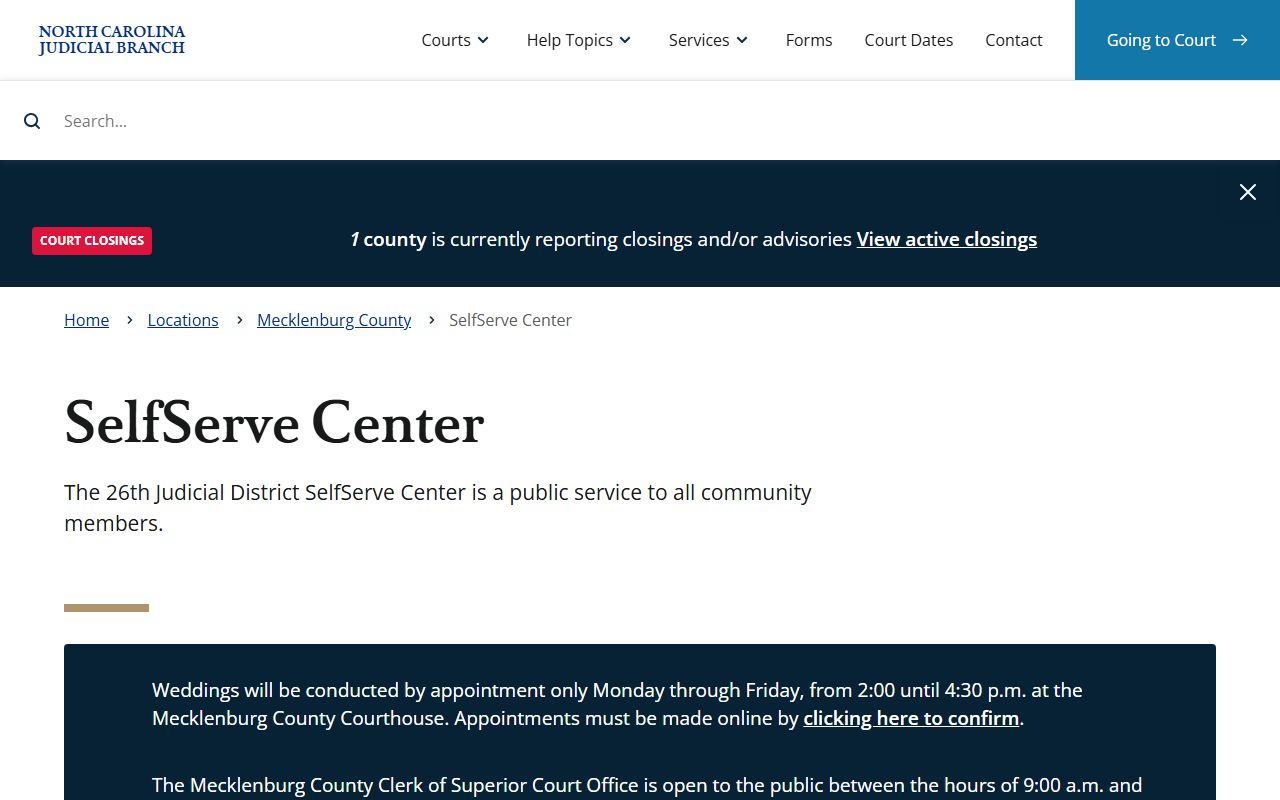
The center is a good first stop for family-law paperwork, but it is not a substitute for an attorney.
Frequently Asked Questions
How do I search Mecklenburg County court records online?
Use the North Carolina eCourts Portal. Pick Smart Search for case records and Search Hearings for court dates. For Mecklenburg, public case information has been available through the Portal since October 9, 2023. Older files that are not in the Portal may need an email request to the correct Clerk of Superior Court division.
What if a record is older than October 9, 2023?
Email the Clerk division that handles the case. Send your request to the criminal, civil, or estates and special proceedings address. Include the type of record you want, the party names, and the file number if you know it. The clerk can then pull the older paper or microfilm file.
Are arrest records the same as convictions?
No. The Sheriff's resident inquiry page warns users not to confuse a charge with a conviction. Many people are charged without ever being convicted. The arrest record may still be public, but the court case shows the real outcome. Always check the disposition in the Portal before you assume guilt.
More answers are on the Mecklenburg County Court Records FAQ page.