
Active Warrants in Mecklenburg County
In Mecklenburg, magistrates within District Court can issue arrest warrants and set bail. Judges issue orders for arrest in pending cases, such as after a missed court date. The criminal magistrates office is reachable at (704) 686-0050. There is no single official website that lists every active warrant for the public to browse.
That absence shapes how a search works. Warrant information surfaces in two places. The eCourts Portal shows orders and case history once they are filed. The Sheriff's inquiry shows process types once a person is booked or held. Neither tool promises to reveal a sealed or freshly issued warrant, so treat a clean search as a clue, not proof.
Types of Warrants in Mecklenburg County
Different warrants come from different triggers. Some start a case, and some respond to a problem in a case already filed. The list covers the common types seen in Mecklenburg court and jail records.
- Arrest warrant - a judicial order to arrest a person for a charge, often issued by a magistrate.
- Order for arrest - issued in a pending case, including after a failure to appear or comply.
- Probation violation - an order for arrest tied to a claimed breach of probation.
- Extradition or out-of-county hold - a hold for another jurisdiction that wants the person.
How to Search Mecklenburg County Warrants
Start with the eCourts Portal Smart Search for case and order history. Then check the Sheriff's resident and arrest inquiry to see if the person is already booked, and on what process type. The Sheriff also runs a civil process inquiry through an official vendor for civil paper service.
Open the Sheriff civil inquiry vendor linked from the resident inquiry page.
For criminal orders, the steps below work best.
- Search the eCourts Portal by name or case number for pending charges and orders.
- Search the Sheriff's resident inquiry for current custody and process type.
- Call the criminal magistrates or the clerk for case-specific status.
Mecklenburg County Warrant Search Fields
Because there is no dedicated warrant portal, the search fields come from the two tools that do exist. The table shows what each accepts.
| Field Label | Type | Required | Notes |
|---|---|---|---|
| eCourts name or case number | Text | One criterion | Finds order and case history if public |
| Sheriff name, PID, or JID | Text | One criterion | Shows process type only if the person is booked |
| Active Inmates Only | Checkbox | No | Narrows to current custody |
| Custody / Prisoner Type | Dropdown | No | STATE, FEDERAL, BOP, ICE, 287G, SMCP |
If the person has not been booked, the Sheriff tool may show no result even when an order exists.
What a Mecklenburg County Warrant Record Shows
There is no public standalone warrant listing, so the closest field inventory comes from a booked resident's charge information. Those fields tell you the order behind a custody record.
| Field | What It Shows |
|---|---|
| Case Number | The trial court case tied to the charge. |
| Description | The charge text. |
| Process Type | The order behind the hold, such as ARREST, FTA, or PV. |
| Charge Type | M, F, T, or I for misdemeanor, felony, traffic, or infraction. |
| Bond / Bond Type | The amount and type, such as SEC or CASH. |
| Disposition | Active, bonded, expired, or inactive. |
Magistrates and the Warrant Process
Magistrates sit inside District Court and play a key role at the front end of a criminal case. They can issue arrest warrants, set bail, and accept certain guilty pleas or waivers for minor matters. That is why the criminal magistrates office, at (704) 686-0050, is often the first court contact tied to a new warrant. The civil and small claims magistrates use a separate line, (704) 686-0560, and handle evictions and small claims rather than criminal orders.
When a magistrate issues a warrant, the order describes the charge and the conditions of release. A booking record may then show a process type such as REL, which is a magistrate's order with charges and release conditions. Keeping the criminal and civil magistrate numbers straight saves a wasted call, since they do different work.
Warrant and Order Process Codes
The Sheriff system uses short codes for the order behind a hold. Knowing them helps you read a record and understand why someone is in custody.
- ARREST
- Held on an arrest warrant.
- FTA
- Order for arrest after a failure to appear.
- FTC
- Order for arrest after a failure to comply with a court order.
- GJI
- Order for arrest after a grand jury indictment.
- PV
- Probation violation order for arrest.
- GOV
- Held under an order of extradition.
What to Do If You Have an Outstanding Warrant
Handle an order for arrest carefully. Identify the case in the Portal first. Call the clerk or criminal magistrates for procedural questions. Then talk to a defense attorney or check public defender eligibility before you act. An active order can lead to arrest and bond processing, so a lawyer can help arrange surrender, bond, or a motion to recall the order.
If the warrant came from a missed court date, an attorney may be able to set a new appearance or file a motion. The fix depends on the code. An FTA points to a missed hearing, while an FTC points to an unmet court order, such as unpaid costs or a class not completed. For a probation violation, the attorney and probation officer review whether bond is set or no bond is allowed. For out-of-state, federal, or immigration holds, release can depend on the other agency even after a local bond.
Important: Talk to a lawyer before turning yourself in, since an outstanding order for arrest can result in immediate custody and bond processing.
Federal Warrants and Holds
Federal warrants are not in the county or state tools. Federal cases sit with the U.S. District Court for the Western District of North Carolina and are searched through PACER, the federal docket system.
Use PACER to look up federal case and docket information.
Federal appeals from this district go to the regional appeals court, not the state appellate courts.
See the U.S. Court of Appeals for the Fourth Circuit, which covers North Carolina federal appeals.
A federal detainer can keep someone in custody even after a local case is resolved.
Restricted Mecklenburg County Warrant Records
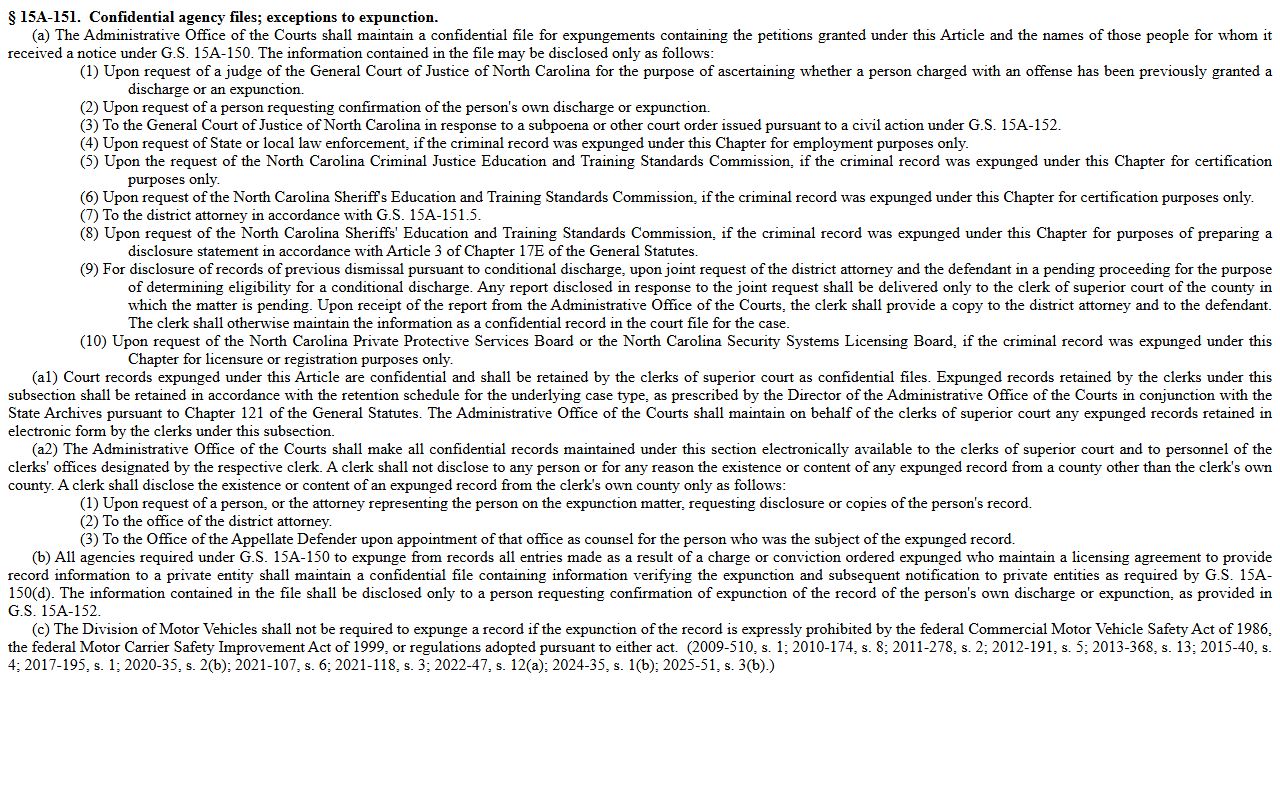
Not every warrant is visible. Sealed warrants, recently issued orders, juvenile matters, and out-of-county warrants may not show in the public tools. Once a case is expunged, the records become confidential under state law.
Read N.C.G.S. 15A-151 on the confidential files kept after a record is expunged.
Because of these gaps, a clean public search does not prove there is no warrant, so confirm with the court or an attorney. Data can also lag, sit with another agency, or be held under seal by court order. The safest approach is to treat the online tools as a starting point and let the clerk, the magistrates, or counsel confirm the real status of any order.