
Arrest Records in Mecklenburg County
Arrest records come from the Mecklenburg County Sheriff's Office, led by Sheriff Garry L. McFadden. When a person is booked into the county jail, the Sheriff creates a booking record with the name, charges, and a mugshot. The office posts this through its resident and arrest inquiry tools. North Carolina law makes this information public, and the Sheriff provides it online for convenience. Arrest and resident inquiry data stays online for three years from the arrest or release date.
An arrest record is not a criminal court record. The booking file shows that someone was charged. The court file, kept by the clerk, shows what happened next. For the full case history, charges, pleas, and disposition, see Mecklenburg County court records. This page leads with arrest data and points to the court file for the rest.
How to Search Mecklenburg County Arrest Records
The main tool is the Sheriff's resident inquiry, which links to arrest inquiry, mugshots, and civil process inquiry. It searches the three-year window of bookings. For case outcomes, the resident inquiry page directs users to the Clerk of Court at 832 East Fourth Street, Charlotte.
- Open the Sheriff's resident inquiry page.
- Choose arrest inquiry to find who has been booked.
- Search by name, or by PID or JID if you have one.
- Open the record to read charges, bond, and booking details.
The Sheriff inquiry is a local tool, not a statewide criminal history. It holds three years of arrest and resident data, and it updates in real time as records change. Each public source answers a narrow question, so it helps to know which one to use. The Sheriff inquiry shows local current and recent arrests, mugshots, charges, and bond. The eCourts Portal shows the court case, hearings, and disposition. A criminal background check through the state court system gives a formal court history. The Department of Adult Correction search covers state prison custody, and the Bureau of Prisons locator covers federal custody. The civil inquiry, by contrast, lists civil process filed with the clerk and does not show case disposition.
The District Attorney and Prosecution in District 26
Once the Sheriff makes an arrest, the District Attorney decides how to prosecute. Mecklenburg is North Carolina Prosecutorial District 26. District Attorney Spencer B. Merriweather III leads the office at 700 East Trade Street, Charlotte, reachable at (704) 686-0700. The office handles violent crime, a trauma-informed team for assault and domestic violence survivors, and programs that route eligible defendants toward treatment.
Visit the District Attorney site for court FAQs, traffic citation guidance, and expungement information.
The DA site is the place to check options before a scheduled court date.
Arrest Records vs Criminal Court Records
An arrest record and a court record are made at different stages by different offices. The booking record starts at the jail. The court record starts when charges are filed with the clerk. The comparison shows the split.
| Arrest Record | Criminal Court Record | |
|---|---|---|
| Source | Sheriff's Office | Clerk of Superior Court |
| Created When | At booking | When charges are filed |
| Contents | Booking info, charges, mugshot | Pleadings, motions, disposition |
Charges vs Convictions
The Sheriff's page makes this point plainly. Do not confuse a charge with a conviction. Many people are charged and never convicted, yet the arrest record can stay public. A charge is an accusation. A conviction is a plea or verdict. The court file shows which one applies.
| Charge | Conviction | |
|---|---|---|
| Stage | Accusation | Plea or verdict |
| Burden of Proof | Probable cause | Beyond a reasonable doubt |
| Where to Confirm | Sheriff inquiry | Court case in the Portal |
Traffic, DWI, and Criminal Charges
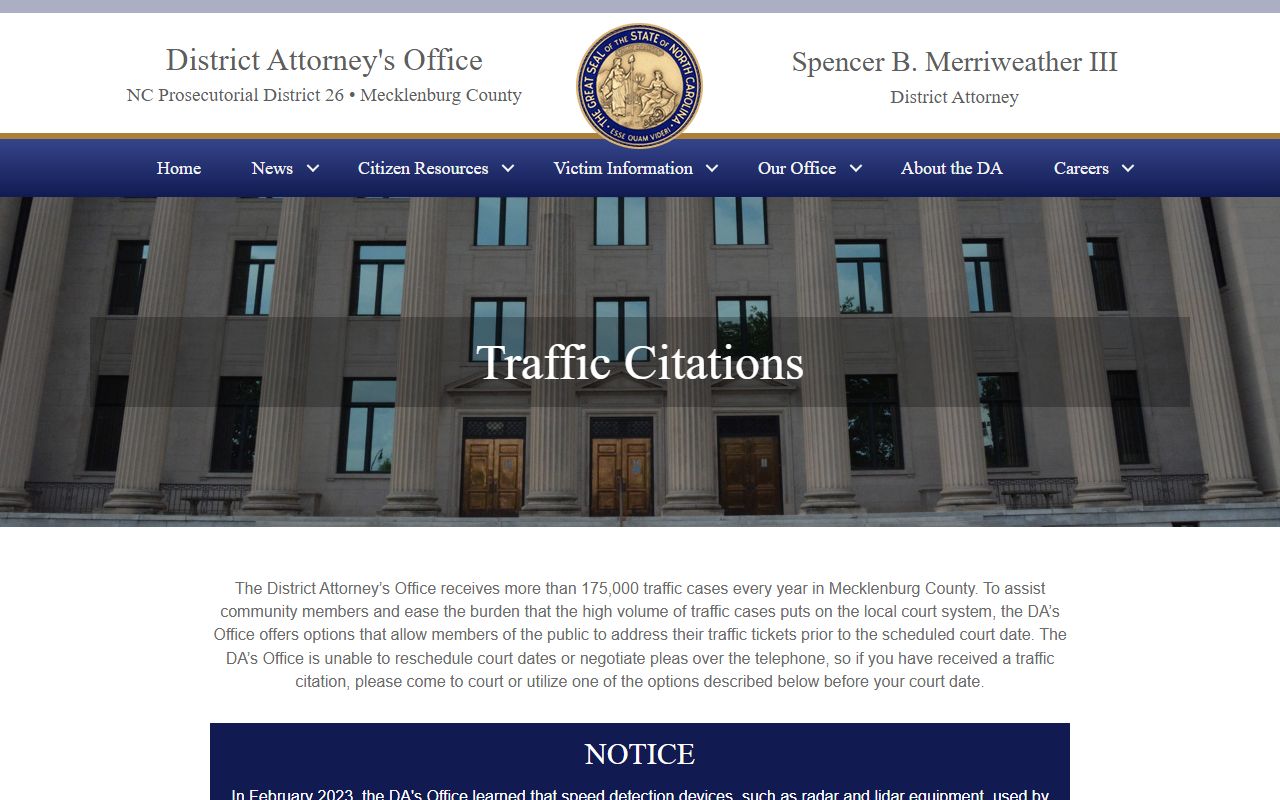
Some traffic matters are criminal, and some are payable infractions. A DWI is a serious criminal charge, not a ticket you can simply pay online. The DA site posts guidance on traffic citations and options before a court date.
See the DA traffic citation page for how minor citations are handled.
For citation lookups and the court-versus-driver-record split, see Mecklenburg County traffic court records.
Sealed vs Expunged Records in Mecklenburg County
Sealing and expunction both limit public access, but they are not the same. A sealed record is hidden but still exists. An expunged record is removed and treated as if the case never happened. North Carolina expunction is statute-specific.
| Sealed | Expunged | |
|---|---|---|
| Visibility | Hidden from public view | Removed from public access |
| Law Enforcement | Limited access | Very limited, confidential file |
| Common NC Route | Court order in allowed cases | N.C.G.S. 15A-146 or 15A-145.5 |
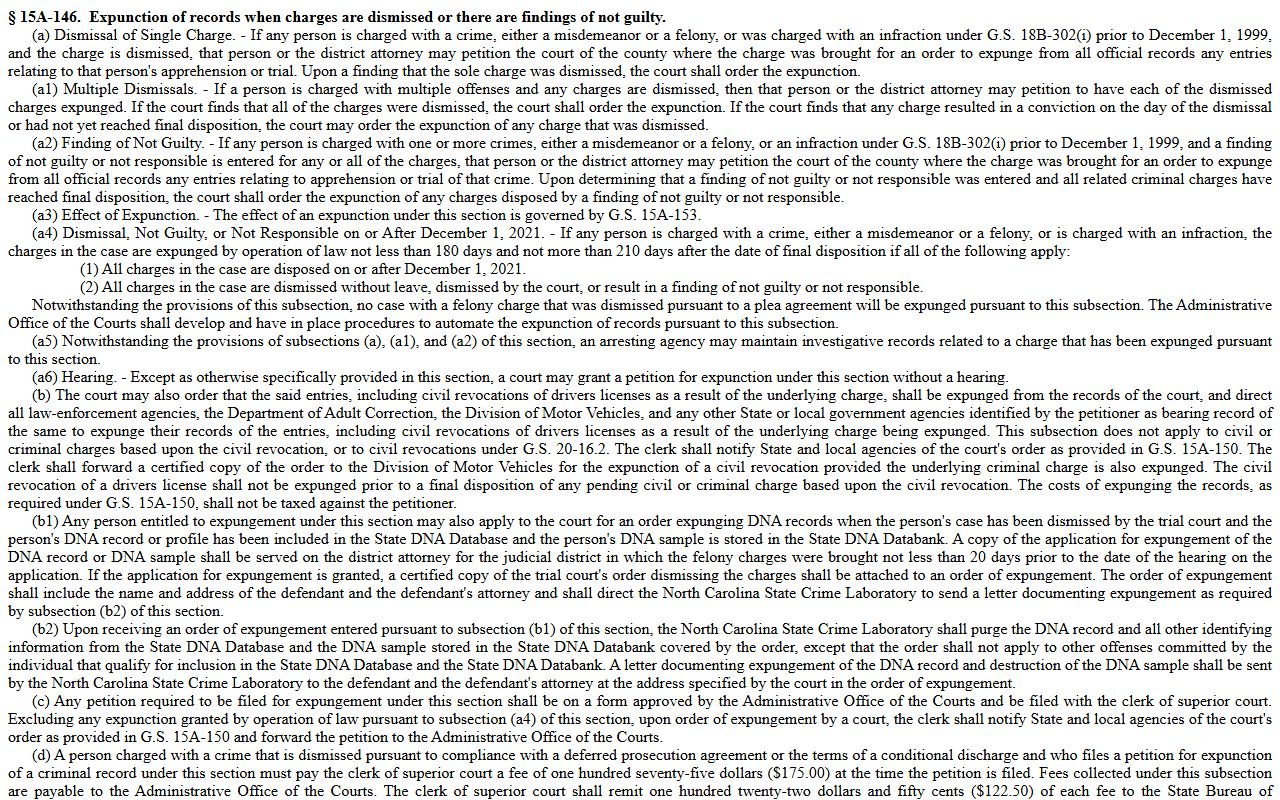
The most common route clears charges that ended in dismissal or a not-guilty finding.
Read N.C.G.S. 15A-146, the expunction statute for dismissed or not-guilty cases.
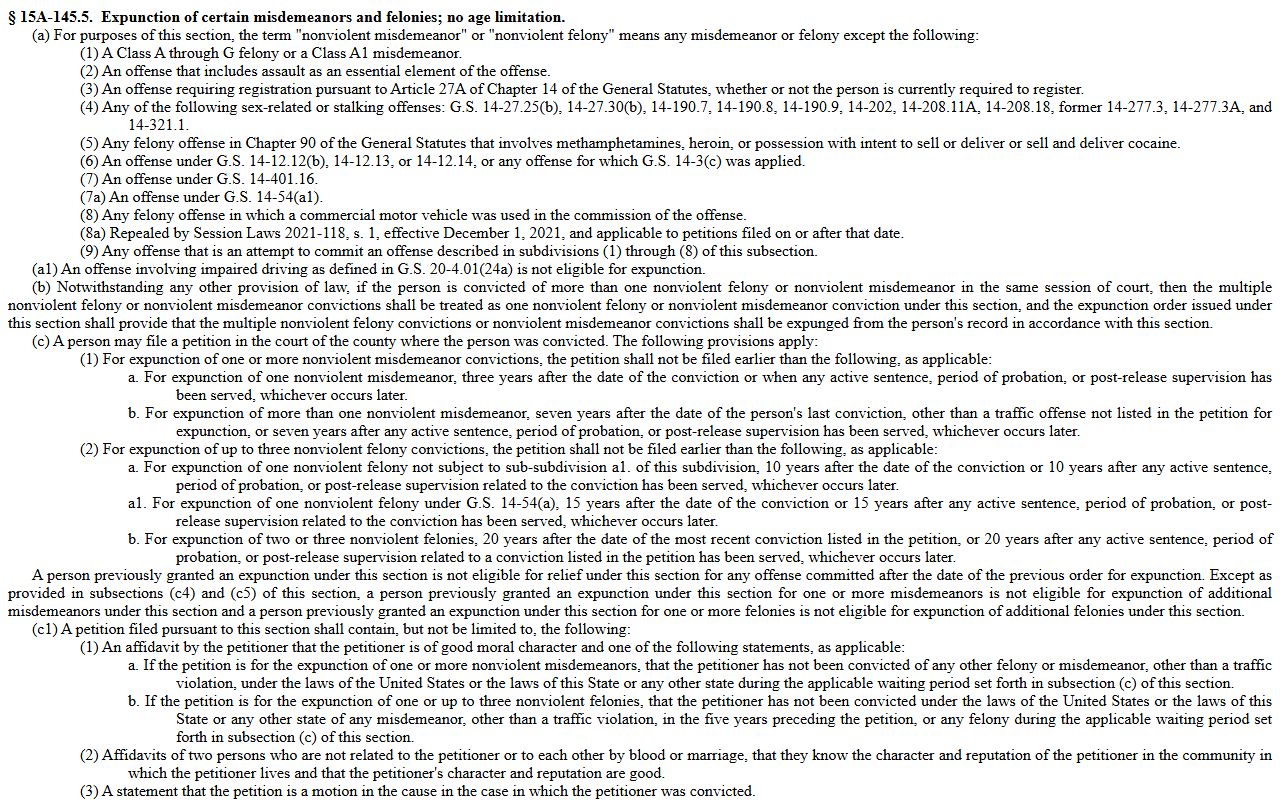
Certain nonviolent convictions can also be cleared after a waiting period.
Read N.C.G.S. 15A-145.5 for expunction of some nonviolent misdemeanors and felonies.
The DA office also explains the local expungement process.
See the DA expungement page for how Mecklenburg handles petitions.
If a judge signs an expunction order, the Sheriff removes the arrest and resident inquiry entry, even before the three-year window ends. A petition usually starts with an AOC form filed in the county of the case, along with the required affidavits. Common denial reasons include an ineligible offense, too many prior convictions, a waiting period that has not passed, or a pending charge.
Mugshots and Booking Photos
The Sheriff's resident inquiry includes mugshots within the three-year online window. The system supports saving an image, with a default save size of 400 by 480 pixels. Because this data is public by state law, the only way to remove it early is an expunction order signed by a judge. There is no informal removal request that works without that order.
Statewide and Federal Criminal Records
The Sheriff inquiry only covers Mecklenburg bookings for three years. For a wider search, use other tools. State prison custody is in the North Carolina Department of Adult Correction offender search. Federal custody is in the Bureau of Prisons inmate locator. The Judicial Branch offers a criminal background check service for a formal statewide court history. Each one answers a different question, so pick the source that matches your need.
Background Check Considerations
A casual lookup and a formal background check are different. A background check used for hiring, housing, or credit must follow the federal Fair Credit Reporting Act and come from a regulated agency. The Sheriff inquiry and the court Portal are public-record tools, not background-check reports.
Important: This site is a private reference and is not an FCRA consumer reporting agency, so do not use it for hiring, housing, credit, or insurance decisions.
Restricted Criminal Records in Mecklenburg County
Some records are closed even though most criminal files are public. Juvenile records are withheld under Chapter 7B. Expunged cases are removed. Sealed cases may show only a notation. Records tied to an ongoing investigation can be held back until the matter is resolved. Personal identifiers are redacted from public copies. When a charge does not appear, it may have been dismissed, expunged, sealed, or filed in another county or in federal court.