
Mecklenburg County Jail Roster Overview
The Mecklenburg County Sheriff's Office, led by Sheriff Garry L. McFadden, operates the county detention system and the public inquiry tools. The resident inquiry page links arrest inquiry, mugshots, and civil process inquiry. North Carolina law makes this information public, and the Sheriff posts it online for convenience. The FAQ states the data runs in real time, so changes to a record show on the web immediately. The system holds three years of data from arrest or release.
The county roster does not cover everyone. It does not show people held in state prison, federal custody, or by immigration authorities elsewhere. For those, use the state Department of Adult Correction search or the federal Bureau of Prisons locator. The Sheriff inquiry is a local jail window, not a statewide or national record.
Open the Sheriff resident inquiry for mugshots, arrest inquiry, and civil process inquiry.
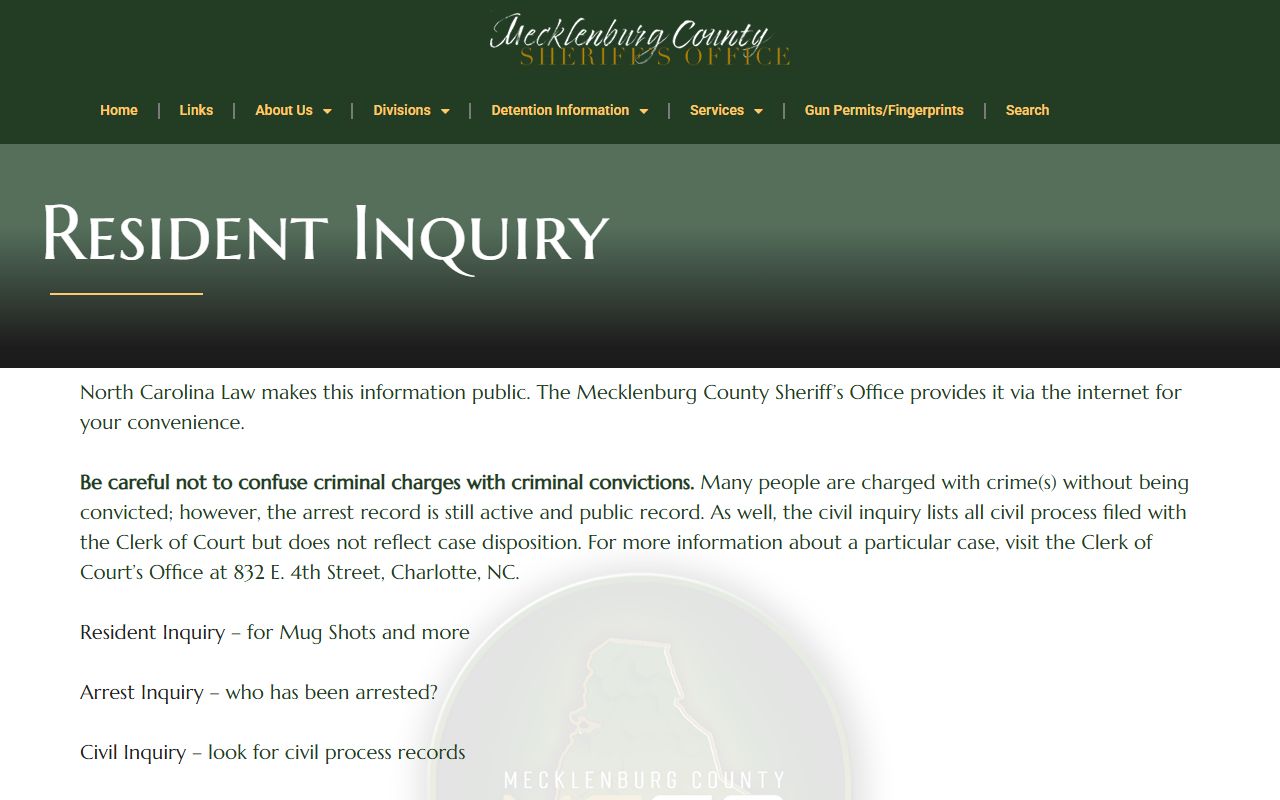
That page links out to the live web inquiry where the actual search runs.
How to Use the Mecklenburg County Inmate Roster
The live search runs on the Sheriff web inquiry system. You can search by name or by an identifier, and you can combine criteria, such as a name plus the active-only switch.
Open the Sheriff web inquiry system to run a live roster search.
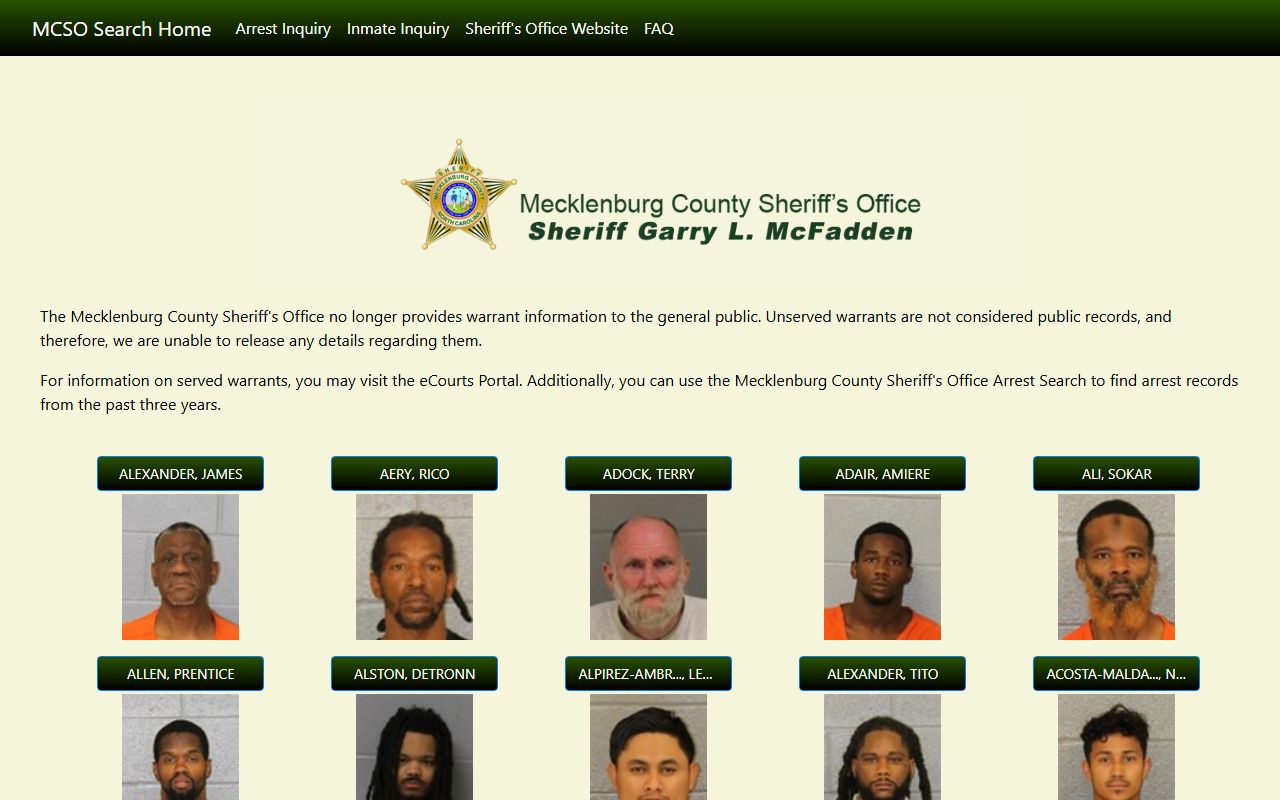
The steps below cover a basic lookup.
- Open the Sheriff web inquiry and choose the inmate or arrest search.
- Enter at least one letter of the first name, or a PID or JID if known.
- Turn on Active Inmates Only to see current custody.
- Open the result to read the summary, charges, bond, and process type.
Mecklenburg County Roster Search Fields
The roster accepts a few search options, and you can use more than one at once. The table lists them with the rules from the official FAQ.
| Field Label | Type | Required | Notes |
|---|---|---|---|
| Name | Text | One criterion | At least one letter for the first name |
| PID | Number | No | Positive ID from fingerprints, constant across stays |
| JID | Number | No | Jail ID assigned at booking, changes each stay |
| Active Inmates Only | Checkbox | No | Narrows to current custody |
| Custody / Prisoner Type | Dropdown | No | STATE, FEDERAL, BOP, ICE, 287G, SMCP |
PID and JID often confuse searchers. PID stays with a person, while JID is new for each jail stay.
What a Mecklenburg County Inmate Profile Shows
A search returns a short result, then a fuller summary when you open the record. The result lists name, PID, JID, height, and weight. The summary and charge information add the detail below.
| Field | What It Shows |
|---|---|
| Name and Alias | The resident's name and any alias on file. |
| Arrest Number / PID / JID | The identifiers tied to the arrest and stay. |
| Race, Sex, Date of Birth | Basic descriptive summary fields. |
| Date Committed | When the person entered custody. |
| Charge Information | Case number, description, process type, charge type, bond, bond type. |
| Disposition | A active, B bonded, E expired, or I inactive. |
The official FAQ explains these fields and how the system saves a mugshot.
Read the inmate inquiry FAQ for field meanings and code glossaries.
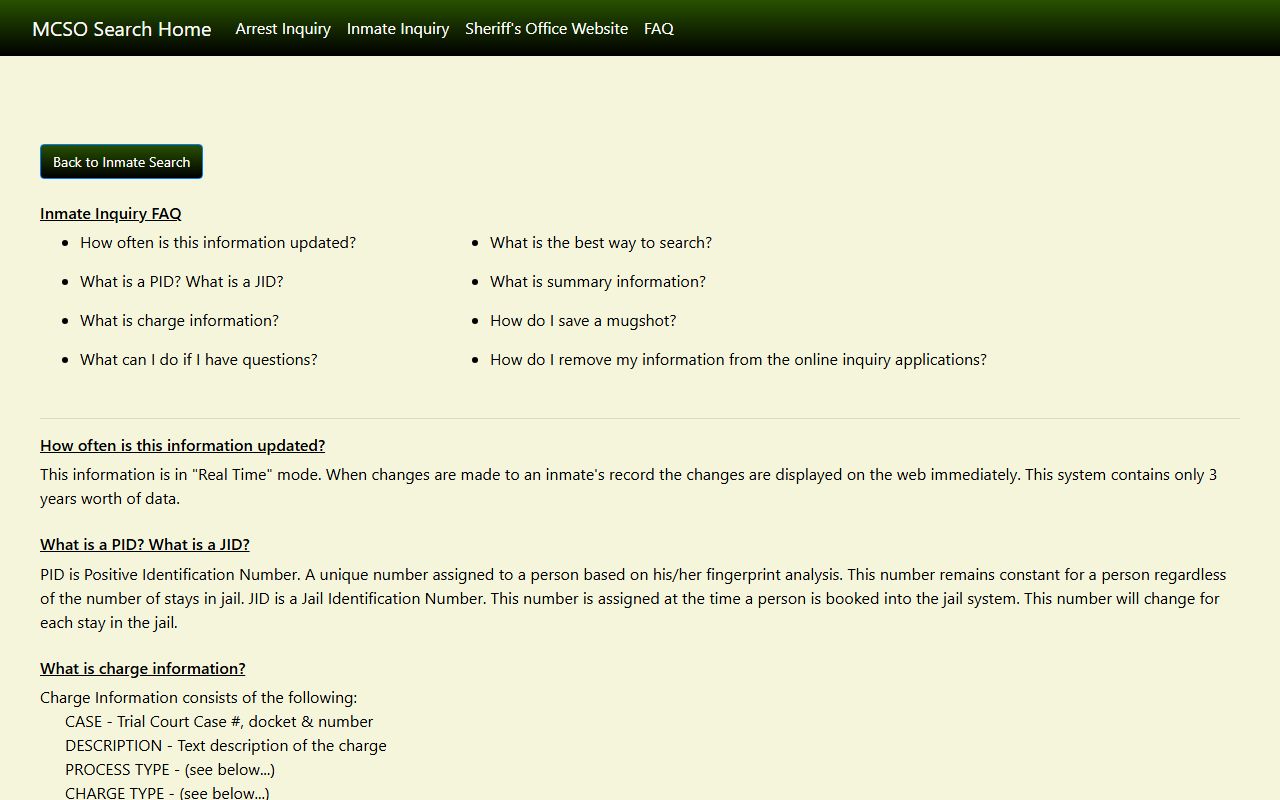
The FAQ also lists the charge type codes: M misdemeanor, F felony, T traffic, and I infraction.
Reading Charge, Bond, and Process Codes
The charge information uses short codes that tell you why a person is held and on what terms. Learning a few makes a record readable at a glance. The process type explains the order behind the hold, and the bond type explains the release terms.
- ARREST
- Held on an arrest warrant.
- FTA / FTC
- Order for arrest after a failure to appear or failure to comply.
- PV
- Probation violation order for arrest.
- SEC / UNS
- Secured bond requires money or property; unsecured is a promise to pay if conditions break.
- CASH
- Bond payable only in cash.
- NONE
- No bond is allowed.
A resident can carry more than one charge with different process and bond codes, which is why the full charge list matters more than a single line.
Note: The roster shows custody status, not case outcome, so check the court case in the Portal to see how a charge was finally resolved.
Mecklenburg County Jail Facilities
The Sheriff operates Detention Center Central, which handles main jail functions plus resident finance and money release. The Sheriff's administrative office is a short distance away. The current capacity by facility is not published in the sources reviewed here, so confirm capacity with the Sheriff's Office before relying on a number.
Detention Center Central
801 East Fourth Street
Charlotte, NC 28202
(980) 314-5165
Trust account 8 a.m.-5 p.m., 7 days
See the Detention Center Central page for facility information.
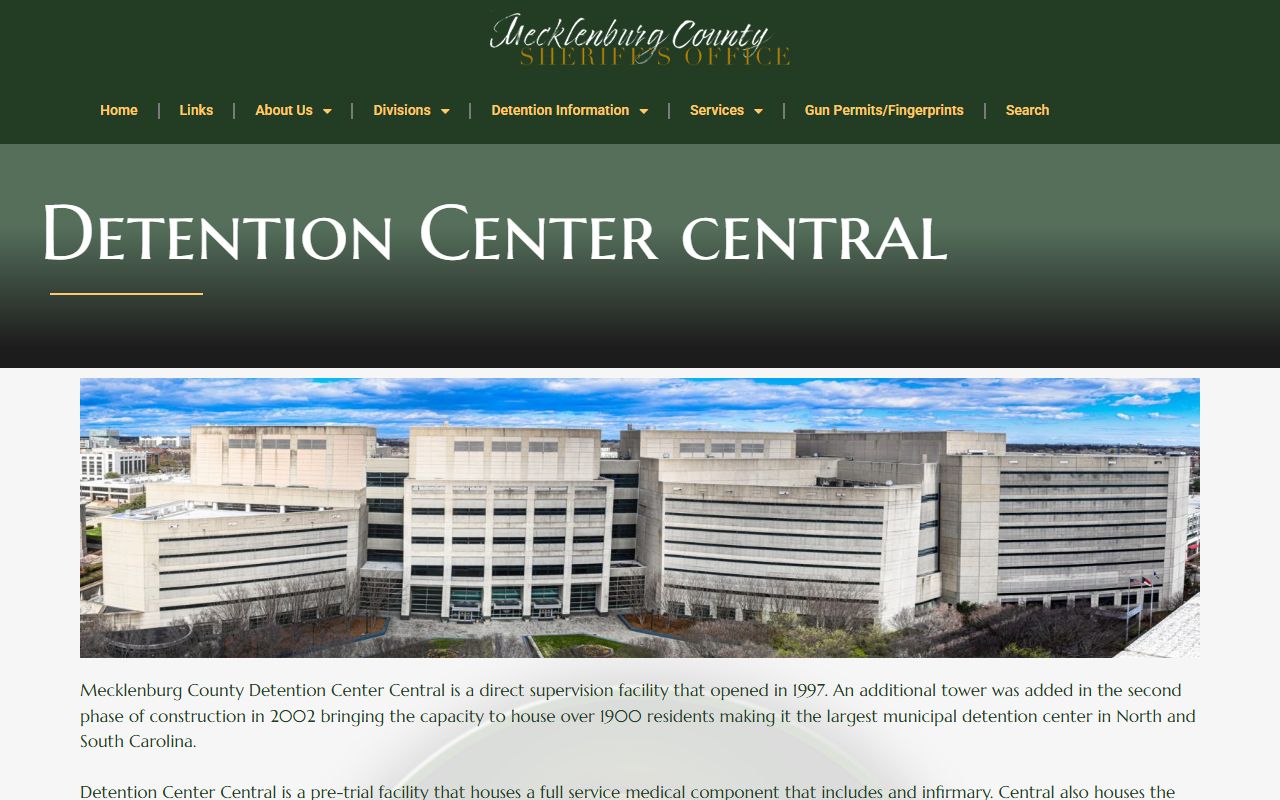
Central is also where released residents close their trust accounts.
Booking Process in Mecklenburg County
Booking starts after an arrest. Staff record the person's name, take fingerprints, and assign a PID and a JID. The charge information lists the case number, description, process type, charge type, and bond. A magistrate sets release conditions, which is why a record may show a REL process type, meaning a magistrate's order with charges and release conditions.
From there, the case moves into the court system. The jail record shows custody status, while the court case shows the charge outcome. Reading both together gives the full picture, since a resident can stay in custody on one hold even after another charge is resolved. Classification staff also decide housing based on charge level and other factors, which is why two residents booked the same day may be held in different units.
Visitation Hours and Rules
Visitation rules, visitor identification, dress code, and the video visit provider are set by the Sheriff and can change. The detailed schedule is not reproduced here because it was not available in the sources reviewed. Confirm current days, times, and rules on the official visitation page before you travel.
Legal mail and attorney visits follow separate rules. Legal mail is opened in the resident's presence to check for contraband. Plan any visit around the current posted schedule rather than an old one.
Note: Always confirm the current visitation schedule and ID rules with the Sheriff's Office, since detention visitation policies change without much notice.
How to Contact a Mecklenburg County Resident
Personal mail goes to the Sheriff's mail processing address: resident name and identifier, P.O. Box 247, Phoenix, MD 21131. Do not send money to that address. Incoming mail must show the resident's first and last name and PID, plus a return address, or it is returned. Certified or registered mail that needs a signature is not accepted.
Books, magazines, and periodicals are accepted only from a bookstore or publisher and must include an invoice. Hardback books are not allowed. A resident may keep five books and five magazines in a cell at one time, and excess must be sent out. Legal mail is exempt from standard inspection and is opened in the resident's presence to check for contraband.
The mail rules also bar a long list of items. Photos that are illicit, instructions for making drugs or explosives, gang material, and content advocating violence or hatred are not allowed. Envelopes with perfume, lipstick, stickers, glued contents, or more than ten printed internet pages are rejected. When in doubt, keep mail to plain letters with the resident's name and PID.
Commissary, Deposits, and Inmate Funds
Money for a resident comes by money order, cashier's check, or the TouchPay system. No cash is accepted by mail. Write the resident's name, date of birth, and PID on the instrument, and put the sender's name and address on it and the envelope. The mailed deposit address is the resident's name, P.O. Box 31427, Charlotte, NC 28231-1427.
TouchPay deposits use a kiosk in the lobby, a phone line at 1-866-232-1899 with facility locator number 228201, or the online site.
Use the online TouchPay deposit site to add funds to a resident account.
The account has limits. The maximum balance is $300. A resident can spend up to $100 per week through commissary, with two orders per week and a $50 maximum per order. The schedule below shows the deposit and money windows.
| Function | When | Notes |
|---|---|---|
| Trust account questions | 8 a.m.-5 p.m., 7 days | Line (980) 314-5165 |
| Mailed deposits posted | Monday-Friday | Money order or cashier's check only |
| Money release at Central | 8 a.m.-5 p.m., 7 days | One release per stay, $25 minimum, $2 fee |
| Cash bond money release | 24 hours, 7 days | Payable to Clerk of Superior Court if eligible |
Indigent residents, defined as having no balance over $3.01 in a ten-day period, can get hygiene and stationery kits charged as an outstanding balance.